
 English
 中文
中文 Русский язык
 한국어
한국어
Sanitary Diaphragm vs Butterfly Valve – Which for Dairy?

 by admin
Every dairy processor knows the sinking feeling: a valve that leaks, traps milk residue, or fails during a CIP cycle. Production stops, batches get rejected, and your team spends hours scrubbing hard-to-reach crevices. The heart of the problem often lies in a small but critical component – the valve that controls flow in your hygienic piping.
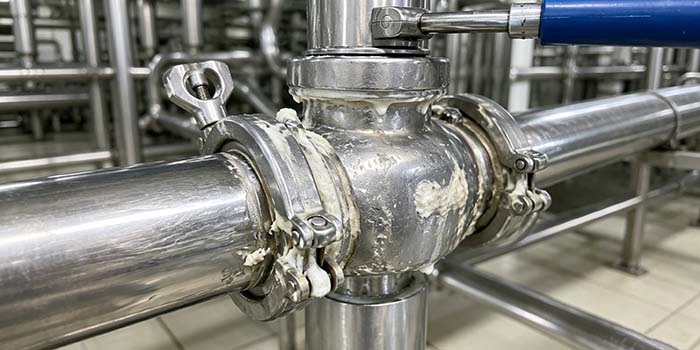
For decades, two valve types have dominated dairy lines: diaphragm valves and butterfly valves. Both are widely used, but they behave very differently when handling milk, yogurt, cream, or whey. Which one truly protects your product integrity and simplifies sanitation?
This side‑by‑side comparison focuses on real dairy conditions – think 4 °C raw milk, hot CIP solutions at 80 °C, and the constant need for crevice‑free surfaces. By the end, you’ll know exactly which valve fits your specific application. And if you’re looking for hygienic valve solutions for dairy lines, we’ve gathered detailed specifications here to help you compare options.
Why Valve Choice Matters More Than You Think
Dairy products are unforgiving. Milk fat and proteins adhere easily to any rough surface, tiny gaps, or stagnant zones. Bacteria like Listeria or Pseudomonas flourish in those hidden spots. A poorly designed valve doesn’t just waste product – it becomes a recurring contamination source that audits will flag.
According to the 3‑A Sanitary Standards, any wetted surface must be free of pits, crevices, and dead spaces. Both diaphragm and butterfly valves can meet this on paper, but their real‑world performance in dairy lines diverges dramatically.
Head‑to‑Head: Diaphragm vs. Butterfly in Dairy
Let’s break down five critical dimensions: hygienic design, cleanability, flow control precision, maintenance burden, and total cost of ownership.
1. Hygienic Design & Dead Leg Risk
-
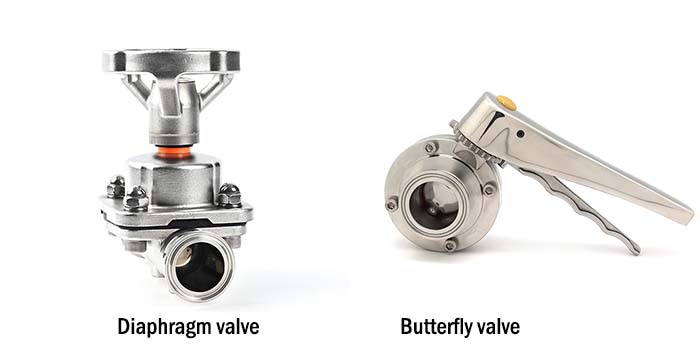
Diaphragm valve: The weir‑type design isolates the actuator and bonnet from the product zone. The flexible diaphragm creates a smooth, self‑draining flow path. No stem packing or seals in contact with the medium. Dead legs are virtually absent when installed correctly.
-
Butterfly valve: The disc sits in the flow stream even when fully open. The shaft penetrates the valve body, requiring stem seals that can trap residue. In the closed position, the disc edges and seat ring may form small crevices – especially problematic with viscous dairy fluids.
Winner: Diaphragm – superior for high‑risk dairy applications.
2. CIP Compatibility & Cleaning Validation
-
Diaphragm valve: The diaphragm lifts completely away from the weir, creating a large, unobstructed opening. CIP spray coverage is excellent. No concave surfaces where soil can hide. Many modern diaphragm valves are EHEDG certified for easy cleanability.
-
Butterfly valve: The disc obstructs flow and creates a low‑flow zone behind the disc. Studies (e.g., from Journal of Food Engineering, 2021) show that butterfly valves often require extended CIP times to remove protein deposits. The hinge area is notoriously difficult to validate.
Winner: Diaphragm – shorter, more reliable CIP cycles.
3. Flow Control & Throttling Accuracy
-
Diaphragm valve: Excellent linear flow characteristic. The diaphragm’s position can be finely adjusted, making it ideal for regulating feed rates to separators, pasteurizers, or fillers.
-
Butterfly valve: Generally used for on/off service. Throttling is possible only between roughly 30° and 70° open, but the disc creates a pressure drop and turbulence. Not recommended for precise dosing in dairy.
Winner: Diaphragm – for any application requiring modulation.
4. Maintenance & Downtime
-
Diaphragm valve: The diaphragm is a wear part that needs periodic replacement. Replacement is quick – remove bonnet, swap diaphragm, reassemble. No special tools. However, if the weir erodes, the entire valve body may need replacement.
-
Butterfly valve: The seat and disc seals wear. Replacement requires removing the valve from the line, which means longer downtime. The shaft bearings also need lubrication and inspection. But butterfly valves generally have a longer interval between major overhauls in clean media.
Winner: Tie – diaphragm wins on quick repair, butterfly wins on longer service life in low‑stress applications.
5. Total Cost of Ownership – 5 Years
| Factor | Diaphragm Valve | Butterfly Valve |
|---|---|---|
| Initial cost | Higher | Lower |
| CIP chemical/water cost | Lower | Higher |
| Spare parts | Moderate | Moderate |
| Labor for maintenance | Lower | Higher |
| Product loss risk | Very low | Low‑moderate |
| Typical TCO | Lower over 5 years | Higher if frequent CIP |
When to Choose Each Valve – Practical Scenarios
Choose a sanitary diaphragm valve when:
-
You process high‑fat products
-
The line is CIP cleaned more than once per day
-
You need accurate flow control
-
The valve is at a critical control point
-
Your auditor demands a documented crevice‑free design
Choose a sanitary butterfly valve when:
-
The valve is only for on/off isolation in a gravity drain line
-
The budget is extremely tight for the initial installation
-
Media is low‑risk water or diluted whey
-
The line is a large diameter, where diaphragm valves become expensive
-
You have validated that CIP can achieve full coverage
Avoid butterfly valves in these dairy applications:
-
Aseptic or UHT lines
-
Direct product contact for raw milk or finished product
-
Any location where milk can stagnate
Real‑World Dairy Example: Yogurt Filling Line
A medium‑sized yogurt producer in Wisconsin switched from butterfly to diaphragm valves on their filler supply header. Before the switch, they observed 3–4 microbiological deviations per year traced back to valve crevices. After replacing ten 2‑inch butterfly valves with weir‑type diaphragm valves, deviations dropped to zero over 18 months. The additional upfront cost was recovered in less than one year through reduced product losses and lower CIP chemical usage.
Installation & Maintenance Tips
To get the best from your chosen valve:
-
Slope and drainage: Mount any valve so that it self‑drains. Avoid horizontal installations that trap fluid.
-
Inspect diaphragm valves regularly: Check for pinholes or hardening of the diaphragm material –an annual visual check under good light is enough.
-
Butterfly valve disc alignment: Ensure the disc fully closes into the seat. Misalignment by 1–2 mm creates a leak path.
-
Never lubricate externally: Use only FDA‑approved lubricants on stems if specified. Most sanitary valves are designed for dry conditions.
Common Myths Debunked
-
Myth: “Butterfly valves are always acceptable for dairy because they have a rubber liner.”
-
Fact: The liner covers the body but not the disc or shaft. Those remain in contact with crevices.
-
-
Myth: “Diaphragm valves are only for aseptic applications.”
-
Fact: Weir‑type diaphragm valves are used daily in Grade A milk plants for standard pasteurized products – they are not exclusive to sterile lines.
-
Your Decision Roadmap
Answer three questions to decide:
-
Does the valve see product during normal flow?
Yes → Diaphragm strongly preferred.
No → Butterfly acceptable. -
Is the line CIP cleaned more than once per shift?
Yes → Diaphragm.
No → Consider butterfly for low‑frequency CIP. -
Do you have a 3‑A or EHEDG requirement for every product contact component?
Yes → Diaphragm (certified options widely available).
No → Butterfly may pass if carefully selected.
Where to Find Reliable Hygienic Valves for Your Dairy Line
Selecting the right valve is only half the battle – you also need consistent quality, documentation (material certificates, surface roughness reports), and technical support. If you’re planning to upgrade your dairy header, filler, or CIP return system, you can explore a complete range of hygienic process valves with detailed 3‑A compliant specifications. Many dairy engineers start with this comparison table of diaphragm vs. butterfly configurations to shortlist models for their P&ID.
For those who need assistance with valve sizing, actuator selection, or CIP validation support, request a customized dairy valve recommendation based on your line diagram.
Disclaimer: This comparison is based on generally accepted hygienic engineering principles and dairy industry practices (3‑A Sanitary Standards, EHEDG Doc. 17, and peer‑reviewed literature). Always validate valve performance with your specific product and CIP protocol. Local dairy regulations may impose additional requirements.
Note: The images in this article are for reference only.