
 English
 中文
中文 Русский язык
 한국어
한국어
QiiMii UHV

 by admin
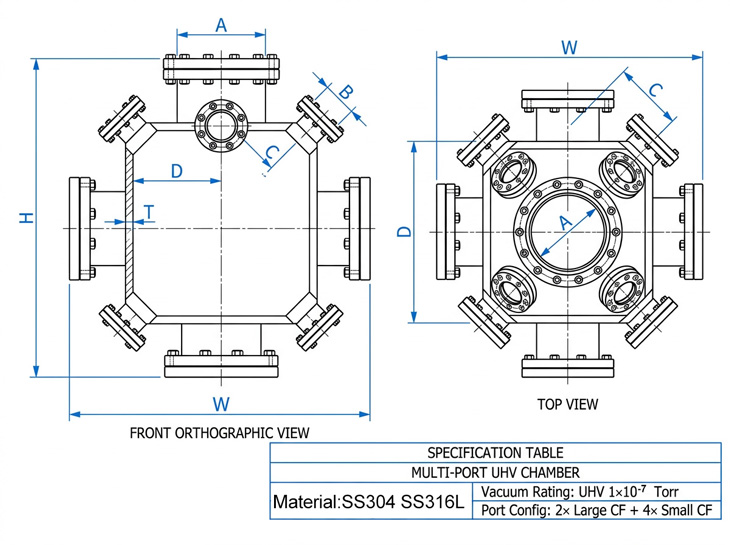
QiiMii UHV (Ultra-high Vacuum) Multi-CF Vacuum Chambers are precise, modular, multi-port fittings and housings that utilize integrated ConflatTM (CF) sealing surfaces at each port. We refer to them as MCFTM or Multi-CFTM vacuum chambers or fittings and they are available in several sizes and configurations. These compact designs are generally compatible with most other vacuum fittings in the industry with the bottom line of facilitating the efficient creation of clean reliable vacuum environments.
CNC Fabrication
As previously noted, these monolithic structures are fabricated from a single piece of metal stock using advanced CNC technology. This fabrication approach allows for the efficient use of material volume and structure in these configurations when compared to other structures in the industry that are typically fabricated from multiple component pieces that have been welded together. A high level of precision is possible with these manufacturing techniques, with port alignment typically within 0.1 degrees.
ConFlat® Flange Sealing Surfaces
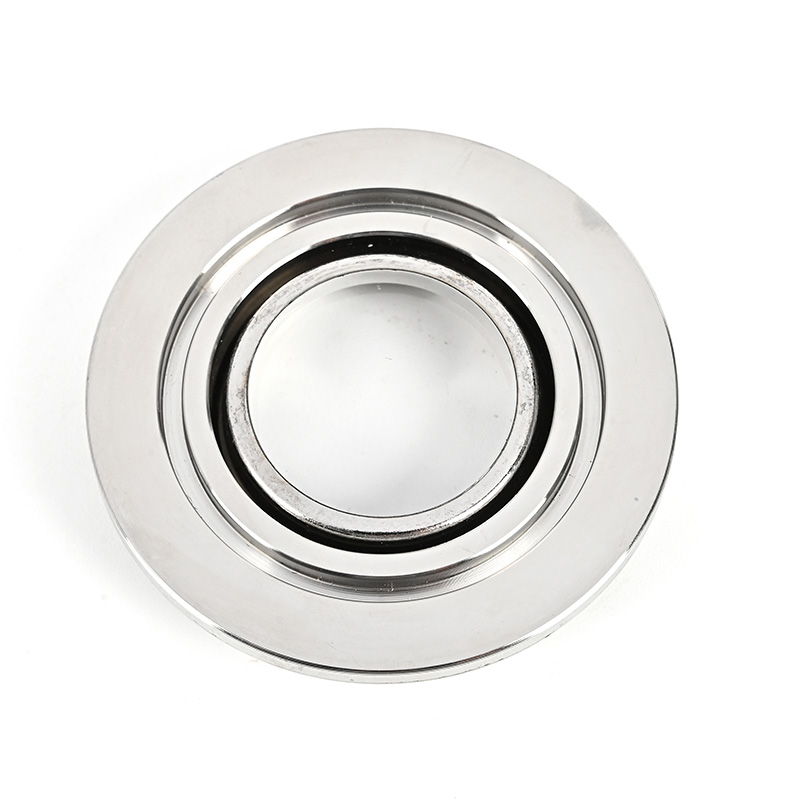
The ConFlat® flange (CF) sealing surfaces are machined directly into the global structure. This sealing surface, which utilizes a knife-edge geometry, is used with an interposed malleable copper gasket and provides both a seal and a structural and stable connection between the flanges of various components. Predictable seals for ultra-high vacuums (UHV) and even extremely high vacuums (XHV) that accompany very low pressure (< 10-11 torr) applications can be reliably obtained over a broad range of temperatures.
The Multi-CFTM inside port diameters (bore diameter) in QiiMii components have been slightly enlarged from conventional designs to allow better access to the chamber’s internal volume and also increase conductance, allowing for more efficient vacuum pumping. These improved port features are still compatible with standard CF sealing surfaces while maintaining their structural and sealing integrity.
Other features of our vacuum chambers that optimize UHV and XHV applications include highly polished mirror-like surfaces, with smooth rounded contour surfaces to minimize internal surface area and with few or no welds within the vacuum space (any welds present are welded from the inner surface). Our distinctive appearance is well-known throughout the industry and attests to the highest levels of precision, quality and function.
Double Density Flange Mounting Holes
A circumferential array of double density threaded holes is typically associated with the flange port of each CF sealing surface port when size allows. This enables the chambers to be clocked or rotated in smaller angular increments and also provides redundancy (e.g. if there is a problem with a bolt and it damages the thread).
The holes are typically available with Standard thread , but metric threads are also available on request . We recommend using silver plated bolts or similar lubrication to reduce friction during bolt placement and prevent thread galling.
Although there are twice as many holes, only half of the holes are typically used to secure the adjacent flange. These added holes also allow for the adjacent chambers to be mounted in similar orthogonal orientations when directly connected to each other using QiiMii Close Coupling Fittings. We discuss Close Couplers in more detail later in this document.
CAUTION: The user should carefully determine appropriate bolt length based on the flange (to be attached) thickness and the depth of the CF port bolt hole. It is recommended that the user confirm their anticipated bolt length on the actual parts by determining the total bolt depth with a caliper depth measurement. If the bolt is “too long”, it will “bottom out” during the tightening process and strip the threads!! In some circumstances, the exact bolt length may not be available and will need to be cut to an appropriate length. The recommended minimal bolt engagement in a bolt hole is one full diameter of the bolt. The ideal engagement is 1.5 to 2.o times the bolt diameter. This can vary and is also related to the materials comprising the bolt and the vacuum chamber bolt hole. The user should do their own research to confirm the best configuration for their application.
Internal Mounting
Internal circumferential channels, that we refer to as Grabber Grooves, are typically present along the inside bore of the CF aperture in ports with sealing surfaces greater or equal than 2.75” inches in diameter (Figure 7). The Grabber Grooves are used to securely attach (mount) various devices and apparatus to the inside of the chamber using Groove Grabber Mounting Clamps / connectors.
The Grabber Grooves typically have the same cross-sectional dimension in all flange diameters allowing for some interchange of Groove Grabber connectors as the port diameter allows.
Mounting flanges and flange adapters are also available that can be attached to other manufacturers’ CF fitting to provide grabber grooves and external mounting channels when there are no integrated mounting grooves available in the chamber structure
QiiMii UHV (Ultra-High Vacuum) Vacuum Chambers are precise, modular, multiport fittings and housings that utilize integrated ConFlatTM (CF) sealing surfaces at each port.
QiiMii Multi-CFTM UHV fittings are designed as both instrument housings and as vacuum chambers, with the specific design intent to:
- Conveniently support a diversity of internal apparatus
- Permit complex port arrangements
- Maximize interior functional volume while remaining compact to minimize their external footprint
- Provide convenient internal access
- Improve pumping efficiency
- Follow a modular dimensioning system
- Cluster together in close proximity
Most of the chambers include internal mounting channels “Grabber Grooves” along the internal bore of their ports (2.75″ or greater) to enable secure mounting of internal apparatus. A circumferential array of double density threaded holes is typically associated with the flange port of each CF sealing surface to enable chambers to be rotated in smaller angular increments while also providing redundancy.
Please learn more about the various Multi-CF Vacuum Chambers designs and geometry with the selected interactive 3D models below. Select the image, let it load, and then interact with the model by moving with your left mouse curser within the window.