
 English
 中文
中文 Русский язык
 한국어
한국어
Sanitary Check Valve vs Pressure Relief Valve – Differences

 by admin
When designing or maintaining a hygienic processing line—whether in food and beverage production, pharmaceutical manufacturing, or biotech—you will encounter various valve types, each serving a distinct purpose. Two devices that are often confused are the sanitary check valve and the sanitary pressure relief valve. While both play critical roles in protecting your system, they address fundamentally different problems. This guide explains what each valve does, how they work, and—most importantly—how to determine which one your process actually needs.
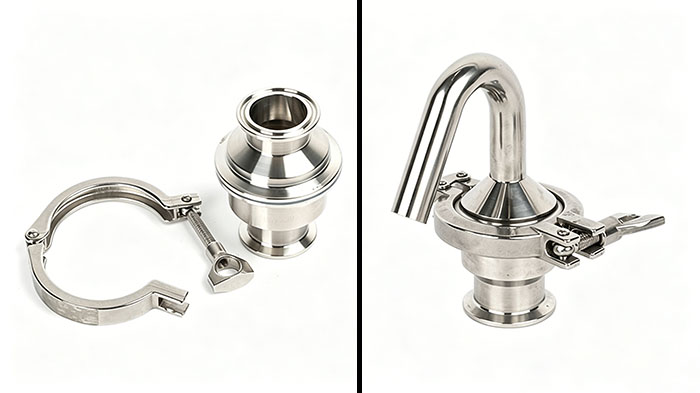
Understanding the Core Purpose of Each Valve
Sanitary Check Valve: Preventing Backflow
The primary function of a sanitary check valve is to ensure one‑way flow. It allows fluid (liquid, gas, or steam) to move forward through the pipeline, but automatically closes to block any reverse flow. This prevents contamination of upstream product, damage to pumps, and unwanted mixing of incompatible media. In hygienic environments—such as WFI (Water for Injection) loops, media preparation lines, and dairy processing—backflow can compromise product sterility and safety. A check valve acts as an automatic gatekeeper, requiring no external control or manual intervention.
Sanitary Pressure Relief Valve: Protecting Against Over‑Pressure
In contrast, a sanitary pressure relief valve protects the system from excessive internal pressure. It remains closed under normal operating conditions. When pressure exceeds a pre‑set threshold—due to thermal expansion, blocked discharge, pump surge, or equipment malfunction—the valve opens automatically to vent the excess pressure. Once pressure returns to a safe level, the valve reseals. This function is essential for preventing burst pipes, gasket failure, vessel rupture, and potential harm to operators. In pharmaceutical fermentation, clean steam systems, and bioreactors, over‑pressure protection is not just good practice—it is often a regulatory requirement.
Key Differences at a Glance
The table below summarizes the most important distinctions between these two valve types. Understanding these differences will help you quickly determine which valve is appropriate for a given process challenge.
| Feature | Sanitary Check Valve | Sanitary Pressure Relief Valve |
|---|---|---|
| Primary Function | Prevents reverse flow | Protects against excess system pressure |
| Trigger Condition | Forward pressure drops below cracking pressure / reverse pressure appears | System pressure exceeds pre‑set limit |
| Operating State | Normally open during forward flow; closes when flow reverses | Normally closed; opens only when over‑pressure occurs |
| Direction of Flow | Allows flow only one way | Flow is bi‑directional; pressure differential determines operation |
| Effect on System | Maintains product purity and prevents cross‑contamination | Prevents equipment damage and safety hazards |
| Typical Set Point | Cracking pressure as low as 2‑3 psig | Adjustable range from 10 to over 100 psig |
| Installation Orientation | Depends on design | Typically vertical or according to manufacturer specification |
| Material & Finish | 316L stainless steel, electropolished | 316L stainless steel, self‑draining design, Ra ≤ 23 µin (0.58 µm) |
| Industry Standards | 3‑A Sanitary Standard 58‑02, ASME BPE | 3‑A 53‑07, ASME Section VIII |
Five Steps to Determine the Right Valve for Your Process
Use the following decision framework when specifying valves for a new or existing hygienic system.
1. Identify the Problem You Are Trying to Solve
Ask yourself: is the risk reverse flow or over‑pressure? If product contamination from downstream sources is the concern—for example, cleaning agents flowing back into a product tank, or pump shutdown causing backflow—a check valve is the answer. If the risk is pressure build‑up from a blocked outlet, thermal expansion, or pump dead‑head, a pressure relief valve is required.
2. Evaluate the Consequence of Failure
Consider what would happen if the valve failed to operate. For a check valve, failure means backflow could contaminate an entire batch, requiring product disposal and line re‑sanitization. For a pressure relief valve, failure could mean a vessel exceeding its maximum allowable working pressure (MAWP)—potentially leading to catastrophic rupture, equipment loss, and safety incidents.
3. Map to Your Industry’s Regulatory Requirements
Different industries have different expectations. In pharmaceutical and biotech manufacturing, cGMP standards demand that any device in contact with product must be cleanable, non‑reactive, and non‑leaching. Both check and relief valves used in these applications must meet ASME BPE surface finish requirements (SF1‑SF6)and use FDA/USP Class VI compliant seals. In food and dairy processing, 3‑A Sanitary Standards provide the governing framework.
4. Assess the Physical Constraints of Your Installation
Where will the valve be placed? Sanitary check valves can be installed horizontally, in vertical up‑flow lines, or—for certain springless designs—in vertical down‑flow drain applications. Sanitary pressure relief valves typically require vertical orientation with the outlet directed to a safe discharge point, and they must be positioned where operators can safely access the blow‑off outlet.
5. Confirm Compatibility with Clean‑In‑Place (CIP) and Sterilize‑In‑Place (SIP) Protocols
Both valve types used in hygienic environments must be compatible with CIP and SIP cycles. Many sanitary pressure relief valves now feature external stem lifters that allow manual opening during cleaning, ensuring all wetted surfaces are exposed to cleaning solutions. Sanitary check valves should be designed without internal crevices or dead legs—springless, crevice‑free designs are preferred for bioprocess and WFI applications because they eliminate the particulate generation associated with traditional spring‑loaded designs.
Common Applications in Hygienic Industries
Understanding where each valve type is typically used can further clarify their distinct roles.
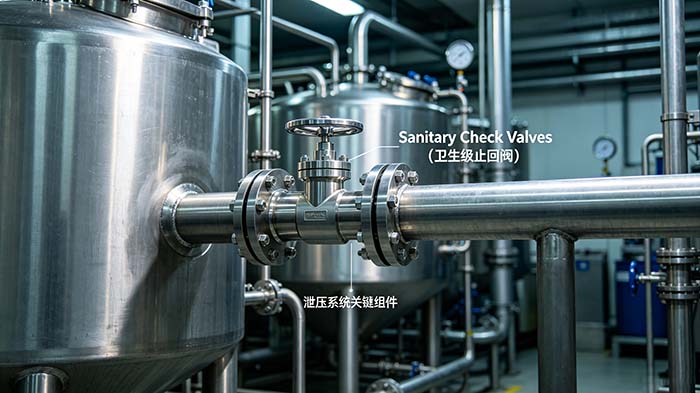
Sanitary Check Valves are commonly found in:
-
WFI loops: installed at pump outlets to prevent backflow when pumps are off
-
Media and buffer preparation lines: preventing backflow during dilution and transfer steps
-
Food and beverage processing: stopping reverse flow of liquids and cleaning agents, thereby maintaining hygienic production standards
-
Pharmaceutical manufacturing: supporting sterile operations by preventing cross‑contamination
-
Separation equipment: waste lines where backflow prevention is critical
Sanitary Pressure Relief Valves are essential for:
-
Bioreactors and fermenters: protecting vessels from over‑pressure during gas sparging and exothermic reactions
-
Clean steam systems: relieving over‑pressure in distribution networks
-
Pharmaceutical formulation vessels: preventing pressure upsets that could compromise product integrity
-
Clean air and gas distribution systems: providing over‑pressure protection at point‑of‑use
-
Vessels containing WFI or USP Purified Water: where thermal expansion can create dangerous pressure spikes
What to Do Next
Once you have clarified the nature of the risk in your process—whether it is backflow prevention or over‑pressure protection—you can move from concept to component selection. Understanding the specific operating conditions of your line will determine the appropriate valve size, material grade, seal type, and surface finish.
For process lines requiring reliable backflow prevention, you may wish to explore the sanitary check valve options designed for pharmaceutical, biotech, and food applications. For systems that require over‑pressure protection, reviewing the specifications of sanitary pressure relief valves that meet 3‑A and ASME standards will be the logical next step.
Related Reading
-
Sanitary Diaphragm Valve vs Ball Valve: Application‑Based Selection
-
Understanding Cracking Pressure in Sanitary Check Valves: What It Means for Your Process
-
CIP Compatibility: How to Evaluate Hygienic Valves for Clean‑In‑Place Operations
-
ASME BPE Surface Finish Requirements Explained
-
Pressure Relief Valve Sizing for Bioreactor and Fermenter Applications
This article is part of Qiming’s technical content library. No direct sales or pricing information is included. All technical discussions aim to help you make informed purchasing decisions.