
 English
 中文
中文 Русский язык
 한국어
한국어
Is a Stainless Steel Mixproof Valve Worth for CIP Lines? | Qiming

 by admin
You are designing or upgrading a hygienic processing line—dairy, beverage, pharmaceutical, or biotech—and you have reached the valve selection stage. You have heard about mixproof valves, also known as double-seat valves. They cost more than standard single-seat valves. But can they actually pay for themselves on CIP (Clean-in-Place) lines? This guide examines the functional differences, efficiency gains, and long-term value proposition of stainless steel mixproof valves in CIP applications, helping you determine whether the investment makes sense for your specific operation.
What Exactly Is a Mixproof Valve—and How Does It Work on CIP Lines?
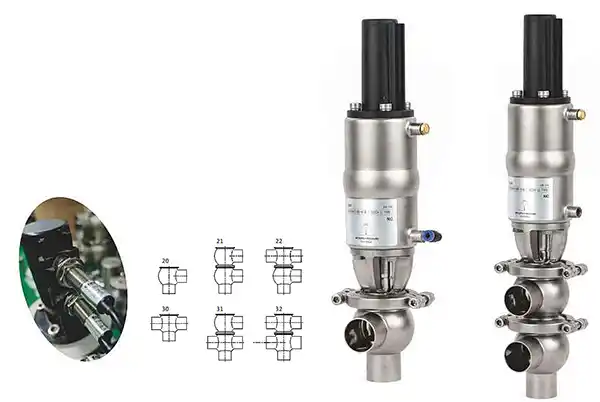
A sanitary mixproof valve, often called a double-seat valve, is designed to safely process two different fluids through the same valve housing simultaneously—typically product and CIP cleaning solution—without any risk of cross-contamination. The key to this capability lies in its construction.
Unlike a single-seat valve that relies on a single seal to separate fluids, a mixproof valve features two independent seats with a leakage chamber in between. When the valve is in the closed position, the two seats isolate the upper and lower pipe lines. If a seal fails, any leaked liquid does not cross into the other pipe—it is directed into the atmospheric leakage chamber and drains out, providing immediate visual indication of a leak while the two fluids remain 100% separated.
On a CIP line, this double-seat design enables what the industry calls simultaneous processing. You can run product through the upper housing while running hot CIP fluid through the lower housing. This means one section of your plant can be cleaned while production continues uninterrupted in another—a capability simply not possible with single-seat valves, which typically require shutting down a large section of the plant to perform CIP.
What this means for your operation: The ability to run CIP and production simultaneously translates directly into more uptime, higher output capacity, and fewer production interruptions.
The Single-Seat vs. Mixproof Valve Comparison
To understand whether a mixproof valve is worth the investment, it helps to see how it compares directly with the more conventional single-seat alternative. The table below highlights the key differences that matter most for CIP line applications.
| Feature | Single-Seat Valve | Mixproof Valve |
|---|---|---|
| Sealing Design | Single seal—one barrier between fluids | Two independent seats + leakage chamber |
| CIP Capability | Requires line shutdown to avoid chemical contamination | Enables simultaneous CIP and production |
| Cross-Contamination Risk | High—seal failure allows fluid mixing | Extremely low—leakage chamber diverts any leak |
| Production Uptime | Limited—CIP cycles interrupt production | Continuous—24/7 operation possible |
| Initial Cost | Lower | Higher |
| Long-Term Value | Limited by downtime and contamination risk | High—ROI often realized within first year |
When to consider each: For simple, non-critical applications where production interruptions are acceptable and contamination risk is low, a single-seat valve may suffice. For high-value industries—pharmaceuticals, dairy, brewing, and biotech—where a single batch contamination can cost thousands of dollars and where uptime directly impacts profitability, the mixproof valve's safety and efficiency features are often non-negotiable.
Five Factors to Evaluate When Considering a Mixproof Valve for CIP Lines
Use this decision framework to assess whether a stainless steel mixproof valve is worth the investment for your specific CIP application.
Assess Your Current CIP Downtime Cost
Calculate how much production time you currently lose to CIP cycles. If you are running single-seat valves, every CIP cycle likely requires shutting down a section of your line. Multiply those lost hours by your production value per hour. If the number is significant, the ability to run simultaneous CIP and production—enabled by mixproof valves—can quickly justify the higher upfront cost.
Evaluate Your Contamination Risk Tolerance
Consider the consequences of a seal failure. With a single-seat valve, seal failure means product and cleaning chemicals can mix—potentially contaminating an entire batch, requiring product disposal, line re-sanitization, and in the worst case, a product recall. With a mixproof valve, the leakage chamber provides a physical barrier that prevents cross-contamination even if a seal fails. For industries with stringent safety requirements—such as dairy processing under the Pasteurized Milk Ordinance (PMO) or pharmaceutical manufacturing under cGMP—this safety feature alone can make the mixproof valve a mandatory choice.
Calculate Your CIP Fluid Consumption
Mixproof valves can significantly reduce CIP liquid consumption. Some advanced mixproof valve designs, when paired with optimized control systems, can cut CIP liquid costs by up to 90%. This is achieved through techniques like seat lift cleaning and seat push cleaning, which clean the valve's internal surfaces more efficiently than conventional methods. Reduced CIP consumption means lower water and chemical costs—savings that accumulate with every cleaning cycle.
Consider Maintenance and Lifecycle Costs
While mixproof valves have a higher initial cost, they often offer lower lifecycle costs. Many modern mixproof valves feature maintenance-free stainless steel actuators, top-loaded designs for easy service access, and standardized seal kits that work across multiple size ranges—reducing inventory costs. Additionally, reduced CIP losses and low air consumption further improve cost savings over the valve's operational life.
Verify Industry Standard Compliance
For many hygienic applications, compliance with industry standards is not optional. Mixproof valves for dairy applications must meet 3-A Sanitary Standard 85-03 for Double-Seat Mixproof Valves. For pharmaceutical and biotech applications, ASME BPE standards govern design and surface finish requirements. EHEDG certification is another common benchmark for hygienic design. If your operation requires these certifications, a compliant mixproof valve is not a matter of “worth it”—it is a requirement.
Real-World Application Scenarios
Dairy Processing Plant
A dairy processor runs pasteurized milk through one line while running CIP cleaning solution through an adjacent line. With single-seat valves, the plant must shut down production for each CIP cycle. By upgrading to mixproof valves that meet 3-A Standard 85-03, the plant can run CIP and production simultaneously. The result: increased production capacity, reduced downtime, and compliance with PMO requirements for safe separation of raw and pasteurized products.
Pharmaceutical Formulation Facility
A biopharmaceutical facility produces high-value formulations where cross-contamination is unacceptable. The facility uses 316L stainless steel mixproof valves with electropolished surfaces (Ra ≤ 0.4 µm) to ensure thorough CIP cleaning and prevent residue buildup. The valves are ASME BPE compliant and support SIP (Sterilize-in-Place) cycles. While the initial investment is substantial, the cost of a single contamination event—potentially millions in lost product and regulatory fines—makes the mixproof valve investment easily justifiable.
Next Steps—From Decision to Selection
By now, you have a framework for evaluating whether a stainless steel mixproof valve is worth it for your CIP lines. The key factors to weigh are: the cost of your current CIP downtime, your contamination risk tolerance, your CIP fluid consumption, and your industry's regulatory requirements.
Once you have clarified these decision factors, comparing the specific specifications of available options becomes the logical next step. You can review mixproof valve designs for continuous CIP applications or explore valve configurations that meet 3-A and EHEDG standards for your specific industry.
Related Reading
-
Sanitary Check Valve vs Pressure Relief Valve – Differences
-
How to Select the Right Sanitary Valve for Your Dairy Processing Line
-
Understanding CIP Compatibility Requirements for Hygienic Valves
-
ASME BPE Surface Finish Requirements Explained
-
Single-Seat vs. Double-Seat Valves: A Complete Comparison Guide
This article is part of Qiming’s technical content library. No direct sales or pricing information is included. All technical discussions aim to help you make informed purchasing decisions.