
 English
 中文
中文 Русский язык
 한국어
한국어
2025 Sanitary Valves Market Size for Food & Biopharma

 by admin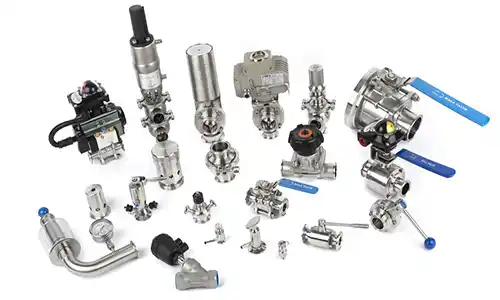
The global sanitary valves market was valued at approximately US$2.0 billion in 2025 and is projected to reach US$2.9 billion by 2032, growing at a CAGR of 5.3%. When including sanitary pumps, the broader Sanitary Pumps and Valves Market is valued at US$3.4–6.06 billion in 2025 depending on the report scope. The food and beverage sector remains the largest end-user, while the biopharmaceutical and pharmaceutical sector is the fastest-growing segment, driven by vaccine production, personalized medicine, and stringent regulatory requirements.
Note on Data Sources: Market size estimates vary significantly across research firms due to differences in definitions. Readers should refer to the cited sources for detailed methodology.
Global Sanitary Valves Market — Key Figures at a Glance
| Metric | Value | Source |
|---|---|---|
| Global Sanitary Valves Market (2025) | US$2.0 billion | Market Glass, Inc. |
| Projected 2032 | US$2.9 billion (CAGR 5.3%) | Market Glass, Inc. |
| U.S. Sanitary Valves Market (2025) | US$618.2 million | Market Glass, Inc. |
| China Sanitary Valves Market (2032 forecast) | US$711.9 million (CAGR 8.7%) | Market Glass, Inc. |
| Global Sanitary Valves Market Growth (2025-2030) | +US$868.4 million (CAGR 6.4%) | TechNavio |
| Sanitary Pumps & Valves Market (2025) | US$6.06 billion | 360iResearch |
| Sanitary Pumps and Valves Market (2025) | US$3.4 billion | OG Analysis |
| Sanitary Pumps and Valves Market (2025) | US$2.8 billion | The Business Research Company |
Discrepancy Note: The US$2.0 billion figure refers specifically to sanitary valves. The higher figures represent sanitary pumps and valves combined — the wide range reflects different research methodologies and market definitions.
For detailed product specifications across the full range of sanitary valves for food and biopharma applications, explore the categories designed for your industry.
Food & Beverage Sector: The Largest End-User Market
The food and beverage industry is the dominant end-user of sanitary valves, accounting for the largest revenue share. Key applications include:
- Dairy processing — fluid transfer, mixing, fermentation, and CIP systems
- Brewing facilities — wort handling, fermentation control, and filtration
- Beverage production — soft drinks, juices, and plant-based/functional beverages
- Processed food — sauce, soup, and ready-to-eat product manufacturing
Key Data Points
| Metric | Value | Source |
|---|---|---|
| Sanitary Valves for Food Processing Market (2025) | US$2.8 billion | Dataintelo |
| Projected 2033 | US$4.2 billion (CAGR 5.2%) | Dataintelo |
| Hygienic Pumps & Valves Market (2025) | US$1.65 billion | 360iResearch |
| Projected 2032 | US$2.55 billion (CAGR 6.38%) | 360iResearch |
| Hygienic Pumps and Valves Market (2025) | US$3.1 billion | MarketResearch.com |
| Projected 2034 | US$5.6 billion (CAGR 6.8%) | MarketResearch.com |
Growth Drivers in Food & Beverage:
- Rising demand for ready-to-consume food products
- Expansion of dairy processing facilities
- Increasing automation in food processing plants
- Growth in plant-based and functional beverages
- Stricter hygiene and safety regulations
Note: The US$2.8 billion figure from Dataintelo refers specifically to sanitary valves for food processing. The US$1.65B–US$3.1B figures represent broader hygienic pumps and valves markets that include both food and other end-use sectors.
To learn more about sanitary valves designed for food and beverage processing, review the product options for hygienic applications.
Pharmaceutical & Biopharma Sector: The Fastest-Growing Segment
The pharmaceutical and biotechnology sector represents the fastest-growing end-user segment for sanitary valves. This growth is driven by:
- Global investments in personalized medicine and vaccine development
- Expansion of biotechnology and biopharmaceutical manufacturing
- Increasing demand for sterile processing in critical applications
- Rising focus on product purity and contamination prevention
Key Data Points
| Metric | Value | Source |
|---|---|---|
| Global Hygienic Control Valves Market (2025) | US$141 million | LP Information |
| Projected 2031 | US$171 million (CAGR 3.3%) | LP Information |
| Global Aseptic Valves for Pharmaceutical (2024) | US$343 million | QYResearch |
| Projected 2031 | US$543 million (CAGR 7.1%) | QYResearch |
| Pharmaceutical Aseptic Diaphragm Valves (2025) | US$280 million | MarketResearch.com |
| Projected 2032 | US$463 million (CAGR 7.6%) | MarketResearch.com |
| Metal Aseptic Diaphragm Valves (2025) | US$145 million | QYResearch |
| Projected 2032 | US$214 million (CAGR 5.8%) | QYResearch |
| Pharmaceutical Segment (2024) | US$779 million | TechNavio |
Note: The "Hygienic Control Valves" (US$141M) and "Aseptic Valves for Pharmaceutical" (US$343M) represent distinct but overlapping segments. The former covers broader hygienic control valve applications, while the latter specifically addresses pharmaceutical aseptic processing. "Pharmaceutical Aseptic Diaphragm Valves" (US$280M) is a subset of the broader pharmaceutical valve market. These figures should not be summed as they represent different product categorizations.
Key Trends in Pharma & Biopharma:
- Emergence of single-use and disposable valve solutions for sterile processing
- Integration of smart sensors and control systems for real-time monitoring
- Adoption of high-purity materials such as SS316L and PTFE linings
- Expansion of vaccine production and cell therapy manufacturing
For sanitary valves suitable for pharmaceutical and biotech applications, explore the configurations designed for sterile processing environments.
Regional Market Insights
United States
The U.S. sanitary valves market is estimated at US$618.2 million in 2025. Stringent FDA and GMP regulatory requirements, a strong pharmaceutical manufacturing base, and the growing craft beverage and dairy processing industries drive the market.
China
China is forecast to reach US$711.9 million by 2032, growing at a CAGR of 8.7% — the fastest among major economies. Growth is driven by expanding pharmaceutical manufacturing hubs, increased consumer spending on processed foods, and rising investments in healthcare infrastructure.
Other Regions
- Japan: Forecast CAGR of 2.6%
- Canada: Forecast CAGR of 5.5%
- Germany: Forecast CAGR of approximately 3.5%
Asia-Pacific Dominance
APAC dominated the sanitary valves market and accounted for 50.4% of global growth during the forecast period.
Growth Drivers Summary
- Regulatory Compliance: Stricter sanitary standards are compelling industries to invest in equipment that meets rigorous hygiene requirements.
- Automation and Industry 4.0: Integration of IoT-enabled valves with real-time monitoring, predictive maintenance, and remote operation capabilities.
- Biopharmaceutical Expansion: Global investments in vaccine development, personalized medicine, and biotechnology research.
- Processed Food Demand: Rising consumer preference for hygienically packaged and ready-to-consume food products.
- Sustainability Focus: Development of energy-efficient, eco-friendly valve designs with reduced friction and waste.
- Tariff Impacts: The introduction of new tariffs in 2025 by the United States has injected further complexity into global supply chains, prompting end users to reassess sourcing strategies and negotiate long-term agreements with domestic manufacturers.
Frequently Asked Questions
What is the difference between "sanitary valves" and "hygienic pumps and valves" market data?
"Sanitary valves" data refers specifically to valves only (US$2.0B in 2025). "Sanitary pumps and valves" or "hygienic pumps and valves" data includes both pumps and valves combined. Always check whether a report includes pumps when comparing figures.
Which sector is larger — food & beverage or pharmaceutical?
The food and beverage sector is substantially larger in total market size (estimated at US$2.8 billion for food processing valves alone). However, the pharmaceutical and biopharma sector is growing at a faster rate, driven by vaccine production, biologics manufacturing, and stringent sterile processing requirements.
What types of sanitary valves are most commonly used in biopharma?
Diaphragm valves, aseptic valves, control valves, and single-use/disposable valves are most common in biopharma applications due to their cleanability, sterility, and contamination prevention features.
How is the U.S. tariff policy affecting the sanitary valves market?
Tariffs implemented in 2025 have increased costs for imported valves, prompting end-users to reassess sourcing strategies, negotiate long-term agreements with domestic manufacturers, and accelerate qualification of local suppliers.
What is the CAGR for the global sanitary valves market?
The global sanitary valves market is growing at a CAGR of approximately 5.3% (2025-2032) according to Market Glass, Inc., or 6.4% (2025-2030) according to TechNavio, depending on the forecast period and methodology.
Which region is growing fastest in the sanitary valves market?
China is the fastest-growing major economy in the sanitary valves market, with a forecast CAGR of 8.7% through 2032. The Asia-Pacific region as a whole accounts for 50.4% of global market growth.
Conclusion
The sanitary valves market in 2025 presents a bifurcated growth story: the food and beverage sector provides the largest revenue base (US$2.8 billion for food processing valves), while the pharmaceutical and biopharma sector offers the fastest growth trajectory, with segments like aseptic valves growing at 7.1% CAGR.
Key takeaways for buyers and specifiers:
- Total sanitary valves market: US$2.0 billion in 2025, growing to US$2.9 billion by 2032
- Largest market: Food & beverage processing
- Fastest-growing segment: Pharmaceutical & biopharma
- Fastest-growing region: China and Asia-Pacific
For procurement and engineering teams, understanding these market dynamics is essential for strategic sourcing, budget planning, and technology selection. The trend toward automation, single-use solutions, and stricter regulatory compliance will continue to shape the sanitary valves landscape through 2030 and beyond.
Once you have identified the right valve type for your application, review the full range of sanitary valve configurations to match your specific process requirements. contact our team for application-specific recommendations.
Data compiled from publicly available market research reports. All figures are estimates and may vary by methodology. For detailed methodology, refer to the original reports cited.