
 English
 中文
中文 Русский язык
 한국어
한국어
Reduce CIP Downtime with Mixproof Valve Configuration

 by admin
The single most effective way to reduce CIP downtime in hygienic processing is to configure mixproof valves that allow simultaneous product flow and CIP cleaning in the same valve cluster. By enabling independent cleaning of one port while another remains in service, mixproof valves eliminate the need to shut down entire production lines for routine cleaning cycles. This article explains how mixproof valve configuration affects CIP efficiency, what to consider when selecting valve configurations, and how to optimize your system for minimal downtime.
What Causes CIP Downtime in Hygienic Processing?
CIP downtime is not simply the time it takes to run a cleaning cycle. In real-world production environments, CIP-related downtime includes:
- Line shutdown and isolation — time required to stop product flow, drain lines, and isolate the section to be cleaned
- Cleaning cycle execution — the actual CIP sequence
- System reconfiguration — time spent manually repositioning valves, reconnecting hoses, or changing gaskets manually
- Post-CIP verification — visual inspection, pH testing, or other quality checks before resuming production
- Unexpected delays — leaks, valve failures, or incomplete cleaning that require repeat cycles
In facilities using conventional single-seat or butterfly valve configurations, each of these steps can take significantly longer because the entire line—or large sections of it—must be taken out of service for cleaning.
How Mixproof Valves Reduce CIP Downtime
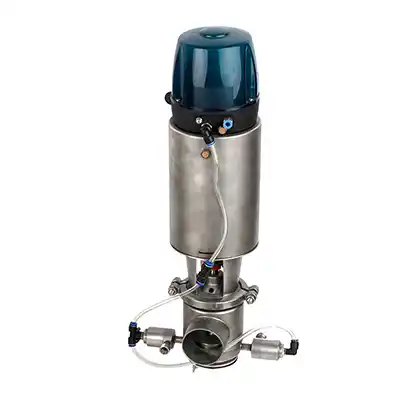
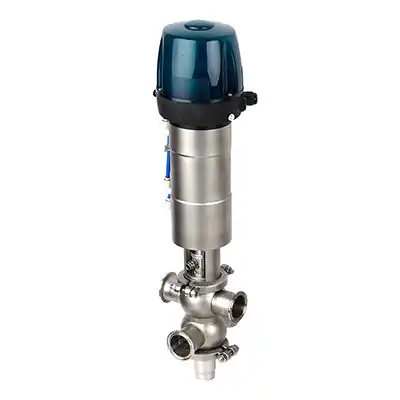
A mixproof valve is designed with two independent sealing systems that prevent cross-contamination between two different media flowing through the same valve body. This design feature has direct implications for CIP efficiency:
| Feature | Impact on CIP Downtime |
|---|---|
| Independent sealing on each port | One port can be cleaned while the other remains in product service |
| Leak detection chamber between seals | Provides early warning of seal failure, preventing unplanned downtime |
| Pneumatic actuation with position feedback | Enables automated CIP sequence control, reducing manual intervention |
| 360º adjustable body | Allows optimal piping layout, minimizing dead legs where product can accumulate |
The most significant time-saving benefit comes from parallel processing: with properly configured mixproof valves, a CIP cycle can run on one side of a valve while product continues to flow through the other side. This means cleaning no longer requires a full production stop.
To explore the full range of sanitary valve configurations available for your application, review the product categories that match your system requirements.
Mixproof Valve Configuration Options That Affect CIP Efficiency
Not all mixproof valve configurations deliver the same CIP performance. The following configuration choices directly impact cleaning time and effectiveness:
Actuator Configuration
The VHS series mixproof valves offer three pneumatic actuator options:
| Actuator Type | Operation | CIP Suitability |
|---|---|---|
| NC | Valve closes when air supply is removed | Suitable for fail-safe cleaning isolation |
| NO | Valve opens when air supply is removed | Useful for drain ports in CIP circuits |
| AA | Both open and close require air pressure | Best for applications requiring precise position control during CIP sequences |
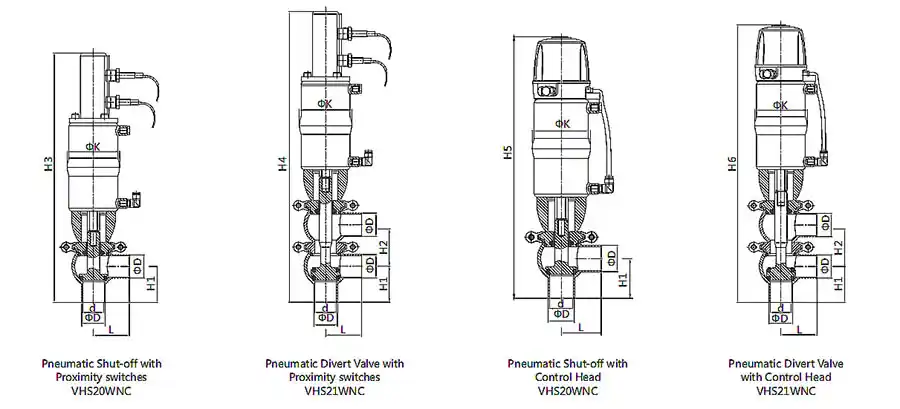
For CIP optimization, AA configuration combined with proximity switches provides the most reliable automated cleaning control, as the valve position can be verified at each step of the CIP sequence.
Seat Seal Material
Seal material selection affects both cleaning effectiveness and seal longevity:
- EPDM (per FDA 177.2600) — Standard for most food and beverage CIP applications; good caustic resistance
- FPM/FKM — Better for higher temperatures and certain chemical CIP agents
- PTFE — Maximum chemical resistance but less elastic; may require longer cleaning cycles
The seal material must be compatible with your specific CIP chemicals and temperatures to avoid premature degradation that leads to unplanned downtime.
Body Configuration
Different body configurations serve different CIP strategies:
- Single-body — Simplest configuration; entire valve must be cleaned as one unit
- Multi-body combination — Allows selective cleaning of individual sections
- Weld or clamp connections — Clamp connections enable faster disassembly for manual inspection; weld connections eliminate crevices that can trap contaminants
Proximity Switches and Control Head
The option to equip mixproof valves with proximity switches and a control head enables:
- Position verification — confirming valve is in correct position before and after each CIP step
- Automated sequence integration — valves can be controlled by the plant's PLC or DCS system
- Alarm notification — immediate alert if a valve fails to reach position during CIP, preventing incomplete cleaning
For detailed specifications on actuation options and control accessories, compare the available valve actuation options across different sanitary valve types.
CIP-Optimized Mixproof Valve Selection Checklist
When evaluating mixproof valves for CIP-intensive applications, use this checklist:
| Consideration | What to Verify |
|---|---|
| Port size | Match to line diameter; available 1"-4" or DN25-DN100 |
| Wetted material | SS304 or SS316L; verify compatibility with your product and CIP chemicals |
| Seal material | Confirm compatibility with CIP temperature and chemical regime |
| Actuator type | NC, NO, or AA based on fail-safe requirements and control strategy |
| Position feedback | Proximity switches or other sensors for automated CIP verification |
| Connection type | Clamp for quick disassembly; weld for crevice-free construction |
| Adjustability | 360º adjustable body for optimal installation orientation |
Common CIP Problems Solved by Proper Mixproof Valve Configuration
| Problem | Root Cause | Mixproof Valve Solution |
|---|---|---|
| Product residue found after CIP | Dead legs or improper flow path | 360º adjustable body enables optimal flow routing |
| Seal failure during CIP cycle | Incompatible seal material | EPDM per FDA 177.2600 or specified alternative |
| CIP cycle takes too long | Entire line must be shut down | Independent port cleaning keeps product flowing |
| Manual valve repositioning errors | No position indication | Proximity switches provide automated position feedback |
| Unplanned downtime from leaks | No leak detection | Double-seal design with leak detection chamber |
Best Practices for Reducing CIP Downtime with Mixproof Valves
- Design for parallel cleaning — Configure valve clusters so that at least one port per valve can be cleaned while other ports remain in service.
- Automate valve sequencing — Use control heads and proximity switches to integrate valve positioning into the CIP controller's sequence logic.
- Select seals for your CIP regime — Match seal material to your specific cleaning chemicals and temperatures. EPDM is standard for most food/dairy applications, but verify with your CIP chemical supplier.
- Minimize dead legs — Use adjustable body configurations to achieve optimal piping angles that prevent product accumulation.
- Implement condition monitoring — Track valve cycle counts and seal replacement intervals to predict maintenance needs before they cause unplanned downtime.
- Validate cleaning effectiveness — Use the valve's position feedback to confirm that all cleaning steps completed with valves in correct positions.
Frequently Asked Questions
What is the main difference between a mixproof valve and a standard single-seat valve for CIP?
A mixproof valve has two independent sealing systems that allow one port to be cleaned while the other remains in service. A standard single-seat valve requires the entire line to be shut down for cleaning. This difference can reduce CIP downtime by 50% or more in multi-product facilities.
Can I retrofit my existing single-seat valves with mixproof valves to reduce CIP downtime?
Yes, but retrofitting requires careful evaluation of piping layout, actuator compatibility, and control system integration. The available sizes (1"-4" / DN25-DN100) cover most standard hygienic line sizes. Consult with a valve supplier to assess your specific retrofit requirements.
How do proximity switches help with CIP optimization?
Proximity switches provide electrical confirmation that the valve is in the correct position before, during, and after each CIP step. This allows automated verification of cleaning sequences and immediate detection of valve positioning errors that could lead to incomplete cleaning.
What seal material is recommended for dairy CIP applications?
EPDM per FDA 177.2600 is the standard recommendation for most dairy CIP applications. It offers good resistance to the alkaline cleaners and acidic rinses typical in dairy CIP regimes. Always verify compatibility with your specific CIP chemicals and temperatures.
How often should mixproof valve seals be replaced in CIP-intensive applications?
Replacement frequency depends on CIP temperature, chemical concentration, and cycle frequency. Most manufacturers recommend inspecting seals every 6-12 months and replacing them when signs of wear appear. Monitoring valve cycle counts can help predict replacement intervals.
Can mixproof valves be used in pharmaceutical CIP applications?
Yes, mixproof valves are widely used in pharmaceutical manufacturing, particularly in biotech and sterile processing. Material selection (SS316L) and surface finish requirements are typically more stringent for pharmaceutical applications. Verify that the valve meets your specific GMP and validation requirements.
Conclusion
Reducing CIP downtime is not about running cleaning cycles faster—it is about eliminating the need to stop production for cleaning in the first place. Mixproof valve configuration offers a practical, proven approach to achieving this goal by enabling independent cleaning of individual ports while product flow continues.
Key takeaways:
- Mixproof valves enable parallel cleaning and production, eliminating full-line shutdowns
- Actuator type (NC/NO/AA), seal material, and position feedback all affect CIP performance
- Proper configuration can significantly reduce both scheduled and unplanned downtime
- Always verify material compatibility and valve sizing for your specific application
Before specifying mixproof valves for a new line or retrofit, review the available sanitary valve configurations to ensure your selection aligns with your CIP requirements and production goals.